With the advancement in 3D printing technologies and the considerable progress in 3D printing materials, additive manufacturing has become a complete hi-tech method for producing various parts. The introduction of 3D printing in prototype production has substantially improved product development. As a result, 3D printing has become a viable alternative to CNC machining, a key pillar of manufacturing today. Moreover, additive technologies are already being viewed as an obvious replacement for CNC machining. How valid is this assertion? Can 3D printing oust machining from the smart factory of tomorrow?
Despite the glamor and prospect of 3D printing, it cannot completely replace CNC machining as the dominant technology for fabricating metal parts. However, there is no doubt that additive manufacturing (AM) will have a significant impact on an entire range of production methods. Broadly speaking, both technologies, CNC machining and 3D printing produce the shape of a part by forming material layer by layer. Which of the two methods is more effective, and how will the combination of both solutions affect production?
To find the answers, let's compare the main features of CNC machining and 3D printing being modern day counterparts.
Workpiece materials- Metals are the main materials for CNC machining. In 3D printing, despite the significant increased share of metals, non-metallic materials are still dominant. At the same time, the progress in powder metallurgy has enabled printing parts from difficult-to-cut materials, such as nickel-based superalloys, which completely opens new prospects for additive manufacturing. Physical properties- Metals are isotropic – their properties are the same yet in different ways. In contrast, 3D printed products feature distinct anisotropy. For example, the strength in a horizontal direction is higher than in a vertical direction. Engineering science, which has plenty of theoretical tools and experience for accurately calculating structural behavior, rigidity, and reliability of parts made from isotropic metals, faces difficulties when dealing with 3D printed products. Thus, introducing AM in the production of metal key elements is advancing slowly for understandable reasons; CNC machining is the dominant method for producing critical heavy components.
Generated shapes- CNC machining has various limitations that are mainly caused by the limited access of a cutting tool to the machined surface (especially inner parts). 3D printing, which is free from most constraints, substantially expands the boundaries when producing complex shapes.
Dimensions- Metal removal by CNC cutting facilitates machining parts in a wide dimensional range. 3D printing capabilities are much more modest. In principle, a large-size part may be produced by AM methods, consequently this part should be divided into several smaller links to be assembled after the 3D printing process is complete. However, this process significantly increases production time and raises a question about the required strength and rigidity of the assembled product. Accuracy, repeatability, and surface finish - Today, 3D printers can provide dimensional accuracy of 0.25 mm (.01"), which is far less compared to the precision of CNC machining that maintains tolerances of at least two-three times less. CNC machining also ensures better parameters in contrast to AM methods for repeatability and surface finish.
Economical aspects and sustainability- Despite the large variety of CNC machines and 3D printers which may vary in price according to the characteristics, the price of a 3D printer is considerably lower compared to a typical CNC machine.
The process of cutting material results in chips – intended for recyclable refuse. Sustainable, low waste 3D printing utilizes material more effectively and therefore saves energy.
For limited production runs, particularly prototypes, AM has an obvious economical advantage. But in large-scale volume manufacturing, CNC machining is much faster and more cost-effective. We can continue to analyze other features such as possible structural defects, thermal integrity, the setup, the required workplace, flexibility, etc., however, our analysis is enough to conclude that 3D metal printing will not fully replace CNC machining in the foreseeable future.
In metalworking, AM can be an effective and a fast method for fabricating precise workpieces that are very close to the desired final part shape, especially when related to complex shaped workpieces. The fabrication of intricate workpieces demand CNC machining with minimal stock removal to answer to advanced machining methods where accuracy and surface finish are the essence. 3D printing enables quick and accurate prototyping results and reduces valuable production time for achieving the optimal solution.
3D printing methods are not a substitute for CNC machining, yet complement the machining processes. In addition, metal removal and additive processes are integrated in modern day machines which combine precise multi-axis cutting with 3D printing. Therefore, the one word that best describes the relationship between 3D printing and CNC machining is “together” and not "instead of". The rise of 3D printing intended for manufacturing workpieces will affect the world of cutting tools. Specifically, milling cutters that shape complex parts will be affected as they answer to the growing demands for high efficiency, high accuracy, and high reliability. Ensuring these "triple high" characteristics seems to be a common prerequisite, however, advanced metal cutting solutions demand techniques that answer to less stock removal.
When machining allowances are small, maintaining high metal removal rates requires increased feed and speeds, which can be reached by utilizing high speed machining (HSM) strategies. Milling tools that spin with high angular velocity must be balanced to sustain stable, durable cutting under increased centrifugal forces while minimizing the number of passes. The ideal result is to obtain the surface finish parameters in a single pass that demands highly accurate cutting tools. We can ascertain that solid carbide endmills, assembled tools with exchangeable cutting heads, and precise one-insert profile mills are the first choice for precise and productive machining of complex shapes with minimal stock.
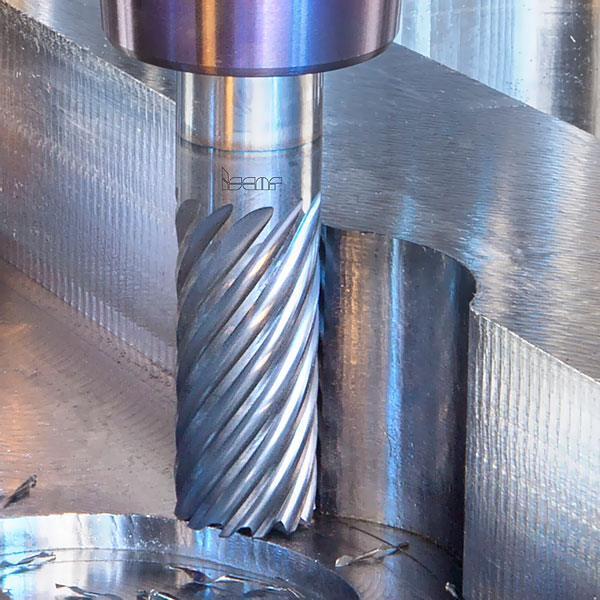
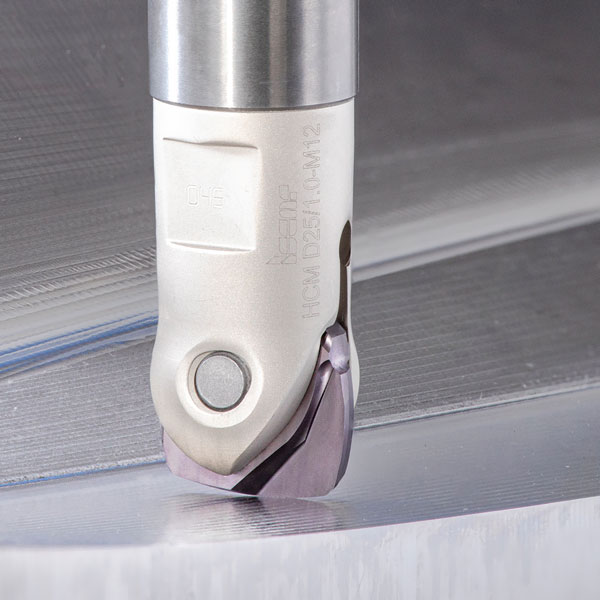
Cutting tool manufacturers account for additive components of metalworking when forming their product portfolio and planning strategically for advanced cost saving solutions. That said, ISCAR has expanded the range of multi-flute solid carbide endmills designed for HSM. ISCAR's latest NEOLOGIQ campaign places special emphasis on "arc segment" or "parabolic" endmills that feature barrel- and lens-shaped cutting edges. These endmills are intended for 5-axis high-speed machining complex profiles providing a perfect solution for productive finishing procedures. Additionally, cutting "barrels" and "lenses" have found themselves in a one-insert indexable tool design that covers greater mill nominal diameters. Evidently, the arc-segment cutting edge was adopted in ISCAR's MULTI-MASTER tool line, the family of assembled tools with exchangeable heads, which combines the advantages of solid and indexable tool concepts.
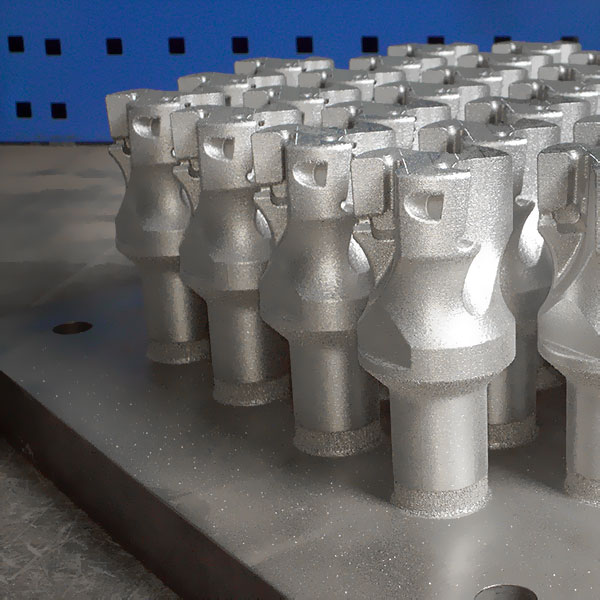
In tool customizing, there is a good example showing the synergy between 3D printing and CNC machining in the production of complicated configurations for special indexable cutters. Despite the limitations, the anisotropic properties of printed products show an advantage. Moreover, 3D printing enables a quantum leap in tool design, optimizing a cutter body configuration, especially for designing and producing inner surfaces and coolant channels for pinpointed coolant.
ISCAR R&D engineers consider AM as a powerful tool in finding the best solution for both special and newly developed products to assure maximum sustainability. The major leap forward relates to 3D printing of carbide inserts. The production of insert prototypes by use of AM methods does not require die sets and enables examining various design versions of the inserts. This method significantly decreases development time, cuts production costs, and minimizes waste.
To conclude, 3D printing today and tomorrow is not meant to replace CNC machining, but the symbiosis of these two technologies will be a typical feature of metalworking technologies soon to come.